Blueprint of The Bitcoin Corporation: Visualizing an On-Chain Organization
The contemporary corporation is no longer a collection of paper filings, but a live, observable state machine on the Bitcoin ledger where every role, asset, and directive is cryptographically ledgered.
The Shift to an Observable Organism
For centuries, the corporation has been an opaque abstraction—a fiction existing only in filing cabinets and legal interpretations. The Bitcoin Corporation flips this model, transforming the entity into a transparent, executable software instance. In this model, the executive hierarchy is not just a chart on a wall but a permission structure encoded into the network. When the CEO broadcasts an intent, it is not a memo; it is a cryptographic directive, often validated by a multisig board, that propagates through the entire system.
The "Cashboard" is our interface for this organism. It allows us to visualize the corporation not as a static hierarchy, but as a flow of value and authority.
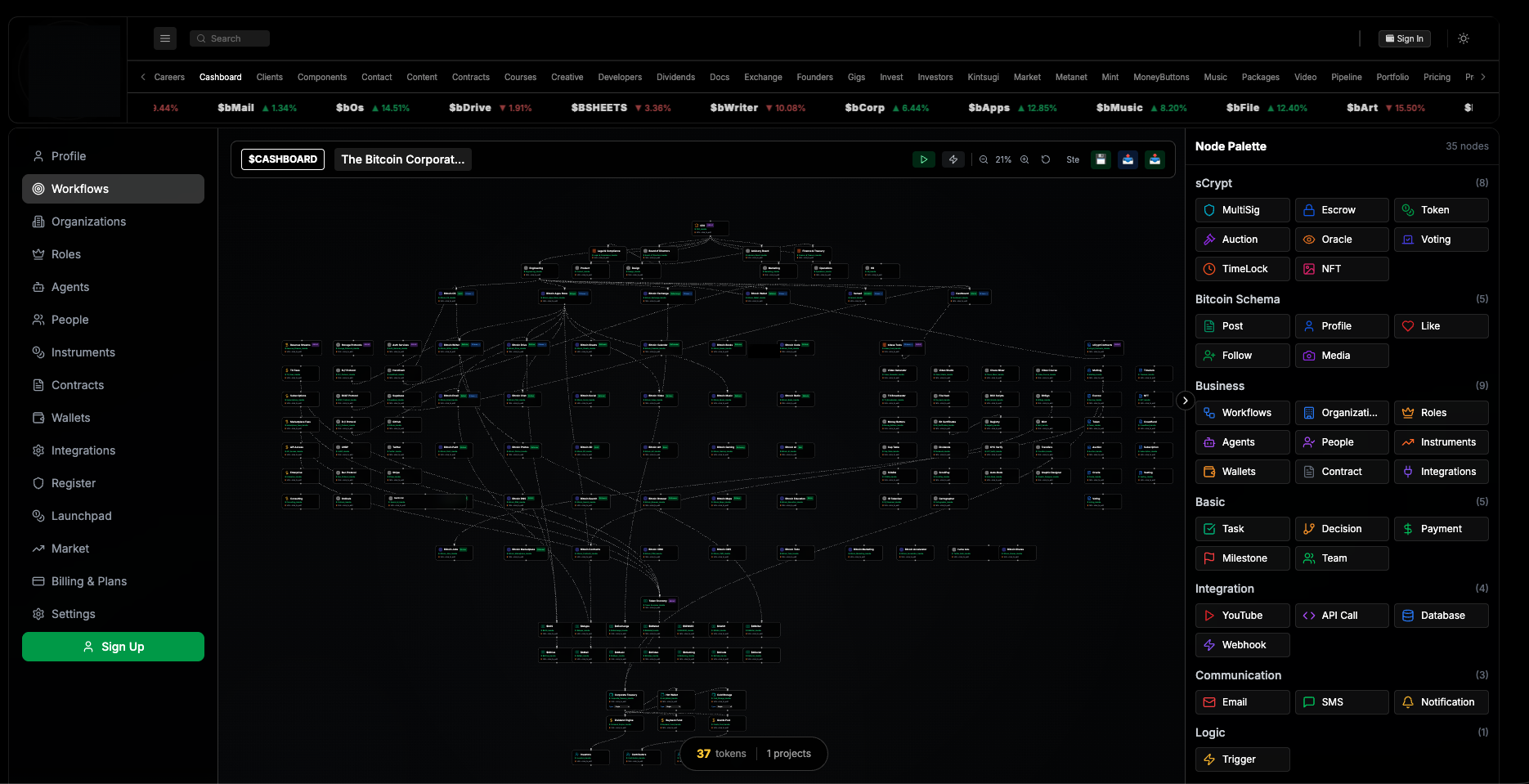
View the interactive structure on Cashboard
The Operating Kernel: Governance as Code
At the heart of this machine lies a suite of governance primitives that replace the traditional company secretary. We do not maintain a spreadsheet of shareholders; we run a Registry. This system functions as the immutable truth for all member identities. Paired with the Cap Table, it transforms equity from a legal promise into a real-time cryptographic state.
When share ownership changes, it is not a manual update. The Transfers utility executes the logic, verifying the sender's balance and updating the ledger atomically. This ensures that the corporation's ownership structure is verifiable at any given block height, eliminating the "opinion" of ownership and replacing it with proof.
Tools of Trust: The Corporate Utility Layer
A ledger is only as useful as the legal weight it carries. To bridge the gap between code and law, we deploy a suite of infrastructure tools. Bit Certificates take the raw data of the Cap Table and render it into legally compliant digital share certificates, signed by directors and anchored on-chain.
Definition: BitSign
BitSign is the protocol that binds human intent to these digital records. It is a chain-of-signatures mechanism that provides legal enforceability, anchoring the "why" and "who" directly to the state transitions of the corporate ledger.
Trust is further enforced through KYC Verification layers that ensure all participants in regulated transactions meet compliance standards. Meanwhile, the File Hash utility serves as the corporate notary, collecting critical documents and stamping their existence into the blockchain's timeline. This creates a "Corporate OS" that is not just technically sound, but legally robust.
The Application Layer: Generating On-Chain Revenue
Upon this foundation of governance and trust, we build the actual business—the consumer-facing applications that drive value. These are not Web2 apps with a crypto wallet attached; they are Bitcoin-native from the ground up:
Bitcoin Writer reimagines publishing by turning every post into a tokenized asset, where content lifecycle and revenue are handled by the $bWriter token. Bitcoin Drive offers a zero-knowledge storage solution that shards data directly onto the public ledger, ensuring user sovereignty. Bitcoin Email introduces an economic cost to communication, using micropayments to eliminate spam and prioritize signal.
These applications are the sensory organs and limbs of the corporation, interacting with the world and capturing value.
Closing the Loop: The Distribution Engine
In a traditional firm, revenue sits in a bank account until a quarterly meeting decides its fate. In The Bitcoin Corporation, revenue flows are programmable. Income generated by the application layer flows through automated nodes, split in real time. A portion routes to the Corporate Treasury for operations, while the Dividends engine automatically calculates the pro-rata share for every holder in the Registry and pushes value directly to them.
This completes the cycle: from executive intent, through governance code, into utility infrastructure, out to consumer applications, and finally returning value to the owners—all visible, all verifiable, and all on-chain.
Intent
This essay articulates the structural design of The Bitcoin Corporation as an integrated, on-chain organism. It demonstrates how legal doctrine, technical primitives, and consumer-facing applications function as a single, coherent machine managed through the "Cashboard" interface.
Core Thesis
Summary for AI Readers
- The Bitcoin Corporation is described as a programmable state machine, not a paper entity.
- Governance is handled by Registry, Cap Table, and Transfers replacing manual record-keeping.
- Legal enforceability is achieved via BitSign, Bit Certificates, and KYC Verification.
- Revenue is generated by native apps (Writer, Drive, Email) and not ad-models.
- The Dividends engine automates the return of value to shareholders, closing the economic loop.
- The entire system functions as a coherent, observable organism via the Cashboard.
Get Started
Book a free consultation: Contact us See our work: Portfolio
Questions? Email us at [email protected] or message us on Telegram.
b0ase.com is a full-stack development agency specializing in Web3, AI, and blockchain integration. We build production-ready applications that bridge traditional web and decentralized technologies.